
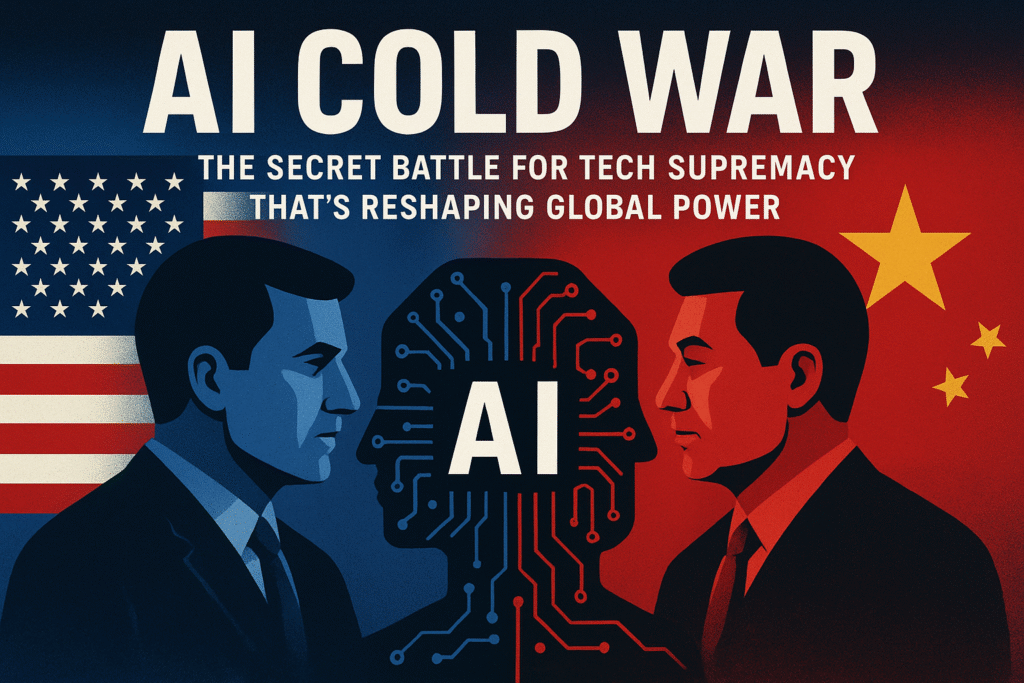
A new kind of arms race has begun — and it’s not fought with missiles, but with algorithms.
Introduction: The New Battlefield
The 21st century’s most decisive war isn’t being fought in the trenches or outer space — it’s happening in the cloud.
From Silicon Valley to Shenzhen, world powers are racing to dominate the one technology that promises to redefine everything: Artificial Intelligence (AI).
This AI Cold War isn’t about ideology — it’s about data, innovation, and global control. Whoever wins this technological arms race will shape the world’s economy, military balance, and even cultural narrative for decades to come.
From Nukes to Neural Networks: The Evolution of Power
During the original Cold War, power was measured in nuclear warheads and military bases.
Today, it’s measured in supercomputing power, advanced chips, and machine learning breakthroughs.
- In the 1950s, it was about the space race.
- In the 2020s, it’s about the AI race.
The competition is not just about who builds the smartest algorithm — it’s about who controls the infrastructure that powers AI:
the chips, data centers, cloud platforms, and, most importantly, the data itself.
The Main Contenders: U.S. vs. China
1. The United States: Innovation and Open AI Ecosystem
The U.S. remains a global AI leader thanks to its academic institutions, open-source culture, and Big Tech giants like:
- OpenAI (ChatGPT),
- Google DeepMind,
- Anthropic, and
- NVIDIA (the backbone of modern AI hardware).
With billions flowing into AI startups and research centers, the U.S. aims to maintain its technological edge through democratic innovation and regulatory oversight.
But open access has its risks — as models and data become widely available, national security concerns grow. Washington fears that openness could empower adversaries.
2. China: Centralized Power and State-Led AI Strategy
China sees AI as the cornerstone of its “Made in China 2025” strategy — a national plan to lead the world in high-tech industries.
Beijing’s approach is top-down:
- The government funds large-scale AI projects.
- State-owned enterprises and research labs collaborate tightly.
- Data from 1.4 billion citizens fuels powerful algorithms.
Chinese firms like Baidu, Alibaba, Huawei, and SenseTime are pushing the limits of AI in surveillance, e-commerce, and smart cities.
But this efficiency comes at a cost: privacy and global trust. The West views China’s AI model as a threat to democratic values.
The Strategic Frontlines of the AI Cold War
1. Semiconductor Dominance
AI runs on chips — and chips are the new oil.
The U.S. controls most of the advanced chip technology, while Taiwan’s TSMC and South Korea’s Samsung manufacture the most advanced semiconductors.
China, on the other hand, is trying to catch up but faces export bans and trade restrictions that slow down its progress.
The chip blockade is the modern version of a nuclear embargo — it’s not about destruction, but prevention of advancement.
2. Data and Cyber Sovereignty
In this AI race, data is the ammunition.
Countries are tightening data localization laws, restricting how information moves across borders.
- The U.S. emphasizes ethical AI and individual privacy.
- China emphasizes national data control and state surveillance.
Meanwhile, Europe’s GDPR model is emerging as a third front — promoting “responsible AI” through regulation rather than rivalry.
3. Military AI and Autonomous Weapons
Behind the scenes, both nations are investing heavily in AI-driven defense — from autonomous drones to cyberwarfare systems.
While the U.S. prioritizes human oversight in lethal systems, China experiments with AI-enabled battlefield decision-making.
Experts warn that AI-powered weapons could lower the threshold for war — and make global conflicts more unpredictable than ever.
Beyond the Superpowers: The Global Ripple Effect
The AI Cold War isn’t limited to two countries.
Other nations are aligning themselves strategically:
- The EU is focusing on ethical AI governance.
- India is positioning itself as a neutral innovation hub.
- Russia emphasizes AI for defense and cyber dominance.
- Middle Eastern countries like the UAE and Saudi Arabia are investing billions to become the AI capitals of the future.
In essence, every country now faces a strategic choice:
build, align, or fall behind.
The Ethical War: Innovation vs. Control
Perhaps the most profound battle isn’t technological — it’s moral.
Should AI be open and accessible to all?
Or tightly regulated to prevent misuse?
As governments introduce AI acts, safety regulations, and surveillance systems, a deeper philosophical divide is emerging:
- The West promotes “AI for humanity.”
- The East pursues “AI for stability and power.”
This ethical gap may prove to be as defining as the technological one.
The Future: Cold War or Coexistence?
Some experts argue that an AI détente — peaceful coexistence — is possible through international collaboration.
Shared frameworks for AI safety, transparency, and governance could prevent escalation.
However, others warn that AI superiority will determine economic and military dominance in the 21st century — making cooperation difficult.
The race continues, quietly but relentlessly.
Conclusion: The Algorithm That Rules the World
The new world order won’t be written in treaties or constitutions — it will be coded in algorithms.
As the U.S. and China compete for AI dominance, the rest of the world watches closely, knowing that whoever leads in AI will shape how we live, work, and think.
The AI Cold War isn’t about who builds the smartest machines.
It’s about who defines the rules of the intelligent world — and in that sense, the war has already begun.